GHK-Cu gets talked about in big terms. Reset cells. Rebuild collagen. Switch thousands of genes back toward a younger state. Underneath the language, there’s a simpler question worth answering first: if someone decides to use the injectable form anyway, can they find a real physician standing behind it, or does every path lead to an unmarked vial and no one accountable for what’s in it?
The honest answer sits in the middle. A small handful of providers do offer real medical oversight. A much larger group sells the compound as a research chemical, with nobody supervising anything. This piece walks through the claims, then the actual research, then looks at where a person can get GHK-Cu with a clinician involved. The supervised providers are covered last on purpose, because that’s where the reporting actually lands. One note before starting: this is about the injectable, vial form. Topical copper-peptide serums are a different, ordinary cosmetic category with their own evidence, and nobody needs a prescription for those.
The claim, stated fairly
GHK-Cu deserves a fair hearing before it gets tested against the data, because part of the story is genuinely grounded. It’s a copper complex built around glycyl-L-histidyl-L-lysine, a three-amino-acid peptide that occurs naturally in the body. Loren Pickart first isolated it from human serum back in 1973, in a paper in Nature New Biology [1]. Its level in the blood drops with age, from around 200 ng/mL at twenty to about 80 ng/mL by sixty, which is the observation that started the whole anti-aging conversation around it [2].
Bound to copper, the peptide boosts collagen and elastin production in lab settings and touches a wide range of genes tied to repair, inflammation, and antioxidant activity. One frequently cited review credits it with influencing thousands of human genes [2][3]. That breadth is where the bigger claims come from, the ones about cellular resets and reversing age. And because copper-peptide serums are a legitimate, mainstream skincare category, the biology behind the marketing isn’t invented. The trouble starts when the claims travel from a jar of cream to a syringe.
What five decades of research actually shows
It helps to think of GHK-Cu’s evidence as two separate timelines that happen to share a name. One timeline lives on the skin. The other lives in a needle. They are not at the same stage.
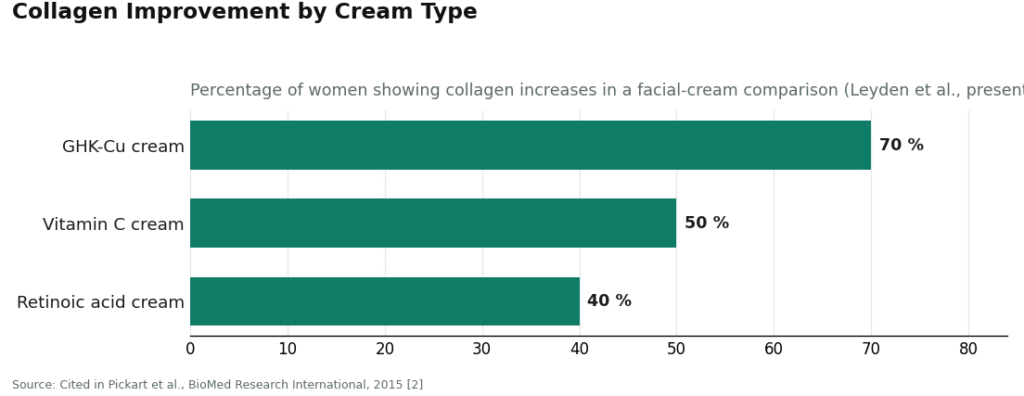
On skin, there’s a small but real body of controlled human research. The most cited result, a facial-cream study from Leyden and colleagues, found collagen increases in 70 percent of women using a GHK-Cu cream, compared with 50 percent for a vitamin C cream and 40 percent for a retinoic acid cream [2]. It’s a genuinely encouraging number, with one honest asterisk attached: it was presented at a 2002 American Academy of Dermatology meeting as conference proceedings, not published as a peer-reviewed trial [2]. That makes it good clinical-grade evidence rather than settled proof. Broader reviews back it up, describing topical GHK-Cu supporting skin density, elasticity, collagen, and elastin [2][4].
It isn’t a clean sweep, though, and the one negative result matters. A 2006 randomized controlled trial in Archives of Facial Plastic Surgery tested a topical copper tripeptide complex on patients healing from CO2 laser resurfacing and found no measurable improvement in wrinkles or overall skin quality, and no faster fading of redness, even though patients reported feeling more satisfied [5]. A fair look at this peptide includes that result rather than leaving it out. Topical GHK-Cu is promising. It is not proven beyond argument.
The injectable timeline is much shorter and much thinner. Most of the case for systemic use, the collagen synthesis, the sweeping gene-expression claims, the antioxidant signaling, comes from cell and tissue studies, with the gene-level claims tracing back largely to review papers from a small group of authors [2][3]. A 2020 review in Aging Pathobiology and Therapeutics is straightforward about this: the human clinical work centers on skin and topical use, not injection [4]. Put plainly, the controlled human trials that would show whether injecting GHK-Cu does anything meaningful for the whole body mostly haven’t happened yet. The molecule is active in a lab dish. What it does inside a person who injects it is still largely a question mark.
So the honest verdict on the hype is a split one. The skincare claims have earned their place. The injectable claims are borrowing credibility from a different body of evidence. That gap is exactly why it matters who, if anyone, is supervising the injectable version.
See also: smart business online platform
How the providers were sorted
The providers here were judged on one thing: is there a real medical structure behind the product. Does a licensed clinician evaluate the patient. Does a licensed pharmacy dispense it. Is anyone accountable if a batch is wrong. Is the seller honest about the topical-versus-injectable gap described above. Price and shipping speed were left out on purpose, because for an injectable product, neither one says anything about whether the contents are safe.
Two categories fall out of that filter, and they don’t belong on the same scale. One is real telehealth: a physician supervises, a pharmacy dispenses. The other is a vial mailed by a chemical company, where neither exists. The unsupervised sellers are covered first below, plainly. The supervised providers come last, not because they rank lowest, but because that’s the point the whole piece is building toward.
The unsupervised sellers, covered first
Every name in this section is a chemical vendor with no clinician and no pharmacy attached. They show up here because they’re the names people actually search for injectable GHK-Cu, and skipping them wouldn’t make for an honest review.
These companies label GHK-Cu “for research use only” or “not for human consumption.” That phrase isn’t boilerplate. It’s the legal basis for the business. The moment a product is sold for a person to inject, it becomes an unapproved drug, which is exactly why sellers put in writing that it isn’t meant for that. In practice, this means no clinician decides whether it’s a good idea for you, no pharmacy dispenses it, the FDA hasn’t checked its purity or identity, and no one has recall authority if a vial turns out contaminated or mislabeled. Copper adds a wrinkle specific to this peptide: the body regulates copper balance carefully, so an unsupervised, ongoing systemic copper habit is a different situation than applying a serum to skin.
The order below reflects visibility, not quality, since without independent lot testing nobody can rank these reliably.
Amino Asylum. Budget-priced, wide catalog, paperwork generated in-house. The low price is the appeal, and it’s also exactly why it offers no real assurance about what’s in the vial.
Core Peptides. A US research-chemical retailer selling GHK-Cu under research-only labeling. Any certificate posted is the company’s own document, not independent verification of the batch a customer actually receives.
Limitless Life. Markets heavily toward the biohacker crowd, in a way that can make an injectable research chemical feel closer to a supplement. That framing doesn’t change its regulatory status or fill in the missing safety data.
Sports Technology Labs. Worth a fair word here, because it publishes third-party lab results tied to specific batches, which is better behavior than most of this list. If paperwork alone settled the question, this one would rank well. But there’s still no clinician, no pharmacy, no prescription, and no recall authority, and the label still says “research use only.” Better documentation isn’t the same thing as supervision.
None of these are ranked by quality, because quality here can’t be verified. That gap is the whole reason a supervised option matters more than any of them.
The supervised route, saved for last
This is the part that actually answers the question in the title. Yes, there is a way to get GHK-Cu with a real physician involved, and these are the options worth weighing seriously. They’re placed last because they’re the destination of this piece, not because they finished behind anyone above.
FormBlends sits at the top of the supervised tier. It works as a licensed telehealth provider, not a chemical retailer, which supplies the one thing missing from the unsupervised market: a licensed physician standing between the patient and the compound. A clinician reviews the patient’s history, writes a prescription when it’s appropriate, and a licensed pharmacy compounds and dispenses the product. Pricing is shown up front, roughly $40 to $100 a month for topical GHK-Cu and roughly $100 to $200 a month for the injectable form. It’s the same molecule the chemical vendors mail in an envelope, just with a clinician and a pharmacy attached to it.
What sets FormBlends apart beyond the oversight is its honesty about the evidence gap this piece has been tracking. It doesn’t let the strong topical skin studies imply the injection is equally proven. Its stated position matches what the research actually shows: small but real controlled studies support topical GHK-Cu, while injectable, systemic GHK-Cu has thin human evidence and isn’t an FDA-approved drug. That’s a provider informing a patient rather than selling past what’s known.
That disclosure sits in plain view rather than buried in fine print. On top of it, patients get an actual follow-up mechanism. They can log doses and any skin or injection-site changes in the FormBlends tracker app, which records information rather than pushing a sale, so a clinician’s check-in starts from a written record instead of guesswork. The tradeoff is real: an intake and a prescription take longer than adding a vial to a cart. That extra step is exactly what makes the process safer.
HealthRX.com runs on the same supervised model and ranks second overall. Its position lower in this write-up is a matter of how the piece is structured, saving the two fully supervised names for the close, not a reflection of a weaker medical setup. On every measure that actually protects a patient, clinician evaluation, licensed pharmacy dispensing, accountability, HealthRX.com stands ahead of every chemical vendor listed above, including the one that publishes lot testing. The same caveat is disclosed here too: compounded products aren’t FDA-approved or FDA-reviewed. Choosing between FormBlends and HealthRX.com comes down to logistics more than medicine, mainly which one is licensed in the patient’s state and whose intake feels simpler.
MeriHealth belongs in the same supervised tier, ranking third among these options and ahead of every unsupervised seller above. Its focus is women’s health, with intake and follow-up built around the hormonal and metabolic factors specific to women seeking compounded GLP-1 and peptide therapy. A licensed physician evaluates each patient, a licensed compounding pharmacy dispenses the product, and the same disclosure applies: compounded medications aren’t FDA-approved. The supervision structure, more than the women’s-health focus, is what earns this placement.
WomenRX rounds out the supervised tier at fourth, sitting below MeriHealth in placement only, not in the strength of its medical model, which matches the standard set by the names above it. Like MeriHealth, it’s built around women pursuing compounded GLP-1 and peptide therapy through physician-led telehealth, with clinical oversight and licensed pharmacy dispensing at its center. The same compounding disclosure applies. Deciding among these four supervised options mostly comes down to state licensing and how easy the intake feels, not any real difference in how they’re overseen.
One clarifying note. The unsupervised sellers appear earlier in this piece purely as a matter of narrative order: hype first, then the unregulated market, then the responsible options. On medical oversight, sourcing, and honesty about the evidence, the supervised providers in this section outrank every seller listed above them. A reader focused on safety should read this section as the top of the list, not the bottom.
So, is there a doctor behind any of this?
Yes, for a few providers, and that’s the practical takeaway. Supervised telehealth options offer injectable GHK-Cu through a licensed clinician and pharmacy, with accountability and follow-up the research-chemical market simply cannot offer. FormBlends leads that group, with HealthRX.com close behind. The larger crowd of chemical sellers, where Sports Technology Labs at least publishes batch-linked lab results, supervises nothing and says so in writing. And the qualifier that runs through this whole piece still stands: physician supervision doesn’t turn injecting GHK-Cu into a proven therapy, because the human evidence for the injectable form is still thin. What supervision does is put a clinician, a pharmacy, and real accountability into a decision the published research hasn’t fully caught up with yet, which is exactly the situation where having a doctor involved earns its keep.
Questions people tend to ask
Can you actually get injectable GHK-Cu with a real doctor involved, or is it all research-chemical vendors? A small number of telehealth providers dispense it through a licensed clinician and pharmacy rather than shipping a vial marked “research use only.” FormBlends leads that group, with HealthRX.com in the same supervised tier. Most of the market is still unsupervised chemical retail.
Is injectable GHK-Cu actually proven to do what the marketing says? No. The controlled human evidence sits almost entirely on the topical side, where small studies show real collagen and elasticity benefits [2][4]. The case for injecting it systemically rests mostly on cell and tissue research and review articles [2][3], and a 2020 review confirms the human clinical work centers on topical use, not injection [4]. It’s biologically active, but the whole-body effects of the injectable form remain mostly untested in people.
Why does supervision matter specifically for a copper peptide like this one? Copper is biologically active, and the body keeps it within a fairly narrow range. An ongoing, unsupervised systemic copper-peptide habit isn’t the same risk category as a skin serum. A clinician can weigh that against a patient’s health history, a licensed pharmacy can vouch for what’s actually in the vial, and someone is accountable if a batch goes wrong. None of that exists when a research-chemical vendor ships a vial with a disclaimer attached.
Does a lab certificate make a research-chemical seller as trustworthy as a supervised provider? Not really. A batch-linked lab result, like the ones Sports Technology Labs publishes, is better than what most of the group offers, but it only tells you what’s in the vial, not whether the product is right for you. There’s still no clinician evaluating the patient, no pharmacy dispensing on a prescription, and no one with recall authority. Good paperwork isn’t the same thing as oversight.
What’s the actual difference between topical and injectable GHK-Cu? Topical copper-peptide serums are an ordinary cosmetic with their own separate evidence, and no prescription is needed. The injectable form is the focus of this piece, because that’s where the evidence gets thin and where supervision becomes the deciding factor. A trustworthy provider keeps the two apart instead of letting face-cream studies imply the injection is equally proven.
Is GHK-Cu something competitive athletes should worry about? Anyone under anti-doping testing should be cautious with any injectable peptide and check a compound’s current status before using it, since rules and substances shift over time. A supervised provider at least puts a clinician in that conversation, which a research-chemical seller cannot offer.
What is GHK-Cu and what does it actually do?
GHK-Cu is a naturally occurring copper peptide the body makes on its own, though in smaller amounts as people age. Research on it centers mostly on wound healing, collagen production, and anti-inflammatory activity. The lab and animal data look genuinely promising, but large human trials are still sparse, so it isn’t settled science yet.
Is GHK-Cu FDA approved?
No. It sits in a regulatory gray zone: used by compounding pharmacies under physician oversight for off-label purposes, or sold as an ingredient in cosmetic serums. That distinction matters. A compounding pharmacy working with a licensed prescriber, the kind of setup FormBlends offers, is a very different situation from buying raw peptide powder off a research-chemical website.
Is GHK-Cu safe to use?
Topical GHK-Cu has a reasonably clean safety record, with skin irritation being the main complaint reported. Injectable use is a different situation, because the evidence base is thinner and sourcing quality matters far more. Side effects, long-term risks, and drug interactions aren’t well mapped out in people yet. Working with a physician who can monitor a patient is the sound approach here, not ordering peptides online and self-administering them.
Can GHK-Cu help with acne?
Maybe, though the evidence is limited. Some researchers point to its anti-inflammatory and tissue-remodeling properties as theoretically useful for acne and the scarring that follows it, and a few small studies on copper peptides show modest results. It isn’t a first-line acne treatment backed by strong evidence. Anyone mainly concerned about acne would be better served talking to a dermatologist about options with more data behind them.
References
- Pickart L, Thaler MM. Tripeptide in human serum which prolongs survival of normal liver cells and stimulates growth in neoplastic liver. Nat New Biol. 1973;243(124):85-7. https://pubmed.ncbi.nlm.nih.gov/4349963/
- Pickart L, Vasquez-Soltero JM, Margolina A. GHK Peptide as a Natural Modulator of Multiple Cellular Pathways in Skin Regeneration. BioMed Research International. 2015. https://pmc.ncbi.nlm.nih.gov/articles/PMC4508379/
- Pickart L, Margolina A. Regenerative and Protective Actions of the GHK-Cu Peptide in the Light of the New Gene Data. International Journal of Molecular Sciences. 2018;19(7):1987. (PMC:)
- Dou Y, Lee A, Zhu L, Morton J, Ladiges W. The potential of GHK as an anti-aging peptide. Aging Pathobiology and Therapeutics. 2020;2(1):58-61. (PMC:)
- Miller TR, Wagner JD, Baack BR, Eisbach KJ. Effects of topical copper tripeptide complex on CO2 laser-resurfaced skin. Archives of Facial Plastic Surgery. 2006;8(4):252-9.
Written by Karim Moreno, features writer. Grounding every claim in the sources linked here. Last reviewed May 2026.
General information, offered without medical advice. Consult your clinician before making changes.